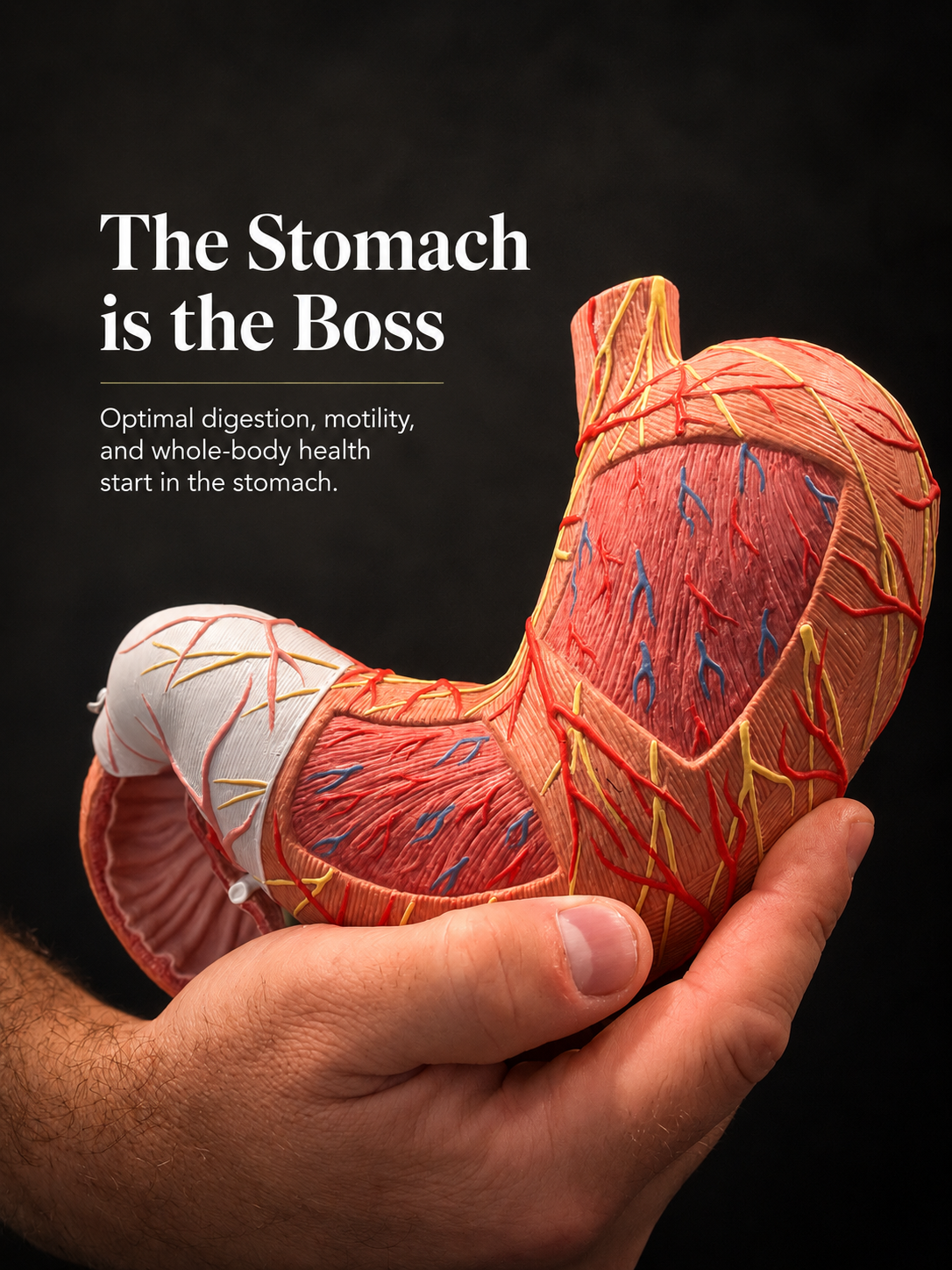
The Stomach is the Boss
Yes, I know. All of your “bits” are important.
But when it comes to digestion, I think the stomach deserves some special attention.
There are two big reasons for this.
First, digestion is a sequential system. What happens at one stage affects what can happen at the next. The stomach sits right near the beginning of that process, which means what happens there can have consequences all the way downstream.
Second, the stomach is incredibly sensitive to what's happening inside it. Through the vagus nerve and other sensory pathways, it's in constant communication with the brain about what's happening inside of us—stretch, fullness, nutrients, discomfort, nausea and whether we're ready for more.
We tend to think of the vagus nerve as the brain telling the digestive system what to do. But a great deal of that information is actually travelling the other way.
The brain is listening to the stomach.
Put those two things together—its position near the beginning of a sequential system and its enormous capacity for sensory feedback—and the stomach has a lot of influence over what happens next.
That's what I mean when I say:
The stomach is the boss.

The Stomach Rules Descending
I first learned this axiom in TCM class at naturopathic college.
Well, I got it right on the test.
But it was only after working on hundreds—probably thousands—of stomachs with trained and sensitive hands that I began to appreciate the deeper wisdom of this simple phrase:
The Stomach Rules Descending.
The stomach isn't the only organ responsible for motility, but it does have one major advantage: it gets the meal first.
As food arrives, the stomach senses stretch and the physical and chemical characteristics of its contents. Those signals help determine how the stomach accommodates the meal, how quickly it empties, and can influence motility much farther downstream.
The gastrocolic reflex is an obvious example. If breakfast—or your morning coffee—makes you poop ten minutes later, it didn't travel through you that quickly. Something happening upstream triggered movement downstream.
This is why, when I'm trying to improve motility, I don't necessarily start by asking how to make the intestine or colon contract harder. I pay a lot of attention to what's happening at the stomach.
Optimizing gastric function and signalling may be one of our most underappreciated opportunities to influence motility throughout the digestive tract.
So yes, like most ancient wisdom, it's true: the Stomach does rule descending.
The Brain Is Listening to the Stomach
We often talk about the vagus nerve as though its main job is for the brain to tell the digestive system what to do.
But much of the information carried by the vagus nerve is actually travelling the other way—from the body toward the brain.
The stomach is constantly generating information about what's happening inside it: how stretched it is, how much we've eaten, whether we're comfortably full—or whether something doesn't feel right.
This is part of interoception: the nervous system's ability to sense what's happening inside our own body.
And we experience the results all the time.
I'm hungry.
I'm full.
That didn't sit well.
I feel nauseous.
I don't want another bite.
These may feel like thoughts or decisions, but they're being influenced by an enormous amount of sensory information coming from the digestive tract.
Every meal stretches the stomach, changes its chemical environment and activates its sensory and motor systems. Most of the time, we barely notice.
But a sensitive stomach doesn't necessarily mean there's more happening in the stomach—it may mean the stomach is responding more strongly to what's normally happening there.
The same amount of food can create a very different experience when the stomach isn't accommodating normally or its sensory signalling has become amplified. Fullness can come too early. Normal stretching can feel uncomfortable. Eating can produce nausea, pressure or simply the feeling that you don't want any more.
And this is where I think we sometimes miss something obvious in clinical practice.
The stomach is a physical organ.
Its function depends partly on stretch, tension, pressure, movement and the ability of its tissues to accommodate a meal. We know that mechanoreceptors in and around the stomach detect these physical changes and that this information can influence fullness, appetite, nausea, motility and how we experience a meal.
Given that, I find it remarkable how rarely we actually assess the stomach physically.
I'm not suggesting that every digestive problem is mechanical, or that hands-on treatment is the answer to every stomach complaint. But if physical information is an important part of how the stomach functions and communicates with the brain, then a skilled, osteopathic-informed physical examination—and, when appropriate, a physical intervention such as visceral manipulation—seems like a very reasonable part of the clinical toolbox.
We routinely investigate the chemistry of digestion. I think there's value in remembering that digestion is physical too.
One pattern I've noticed repeatedly in people with particularly sensitive stomachs is that mornings can be the hardest time to eat. They may have little interest in breakfast—or even feel nauseated by the thought of food—yet become progressively hungrier and more comfortable eating as the day goes on.
There are several possible reasons for this, but it illustrates an important point:
Not wanting to eat isn't necessarily a decision made entirely in your head.
Sometimes your brain may simply be listening to what your stomach is telling it.
Picky Eater, or Sensitive Stomach?
Taste, smell and texture matter. So do behavioural and psychological factors.
But eating is also a physical event, and the stomach sits right at the beginning of it.
If a food repeatedly causes nausea, pressure, reflux, early fullness—or simply “hurts” a very sensitive stomach—how can we blame someone for not wanting to eat foods that make them feel that way?
This may be particularly important in children. A child may not be able to explain what they're feeling. They may simply say:
“I don't like it.”
In Chinese medicine there's another useful concept: Stomach Fire.
I don't mean that the stomach literally burns food, or that more stomach acid is always better. I think of Stomach Fire more broadly as digestive capacity—the stomach's ability to comfortably receive, accommodate, acidify, mix and process what we put into it before handing it off to the rest of the digestive tract.
A strong fire can handle a much wider range of fuel. We incinerate difficult material in an incinerator; we don't throw it onto a tiny campfire and expect the same result.
The same idea can be useful when thinking about food tolerance. The healthier and more capable the stomach, the greater the variety of foods it may be able to comfortably handle. When that capacity is compromised, the range of foods that feel good may become smaller.
That's why I think treating the stomach itself offers an important and often overlooked opportunity in people we describe as “picky eaters” or “food sensitive.”
Rather than continually searching for better fuel, sometimes we need to build a better fire.
Why We Need to Listen to the Boss
The stomach gets the meal early, helps set the pace for what happens downstream, and sends a remarkable amount of information back to the brain about how that meal is being handled.
That means problems at the stomach can show up as more than “stomach symptoms.” They can influence motility, appetite, food tolerance and even whether someone wants to eat in the first place.
This is why I think the stomach deserves a much bigger role in how we assess and treat digestive problems. Sometimes improving what happens downstream means starting upstream.
And in an increasingly virtual medical world, I also think we lose something important when we never physically examine the abdomen. History and testing matter, but so can skilled palpation.
Sometimes we need to start at the top, and sometimes we need to get our hands on the patient.
That, in a nutshell, is why I think the Stomach is the Boss.